
Nebraska State Patrol at a Glance
The Nebraska State Patrol Criminal Identification Division, or CID, sits within Administrative Services. It is Nebraska's central repository and state criminal justice information interface. CID receives fingerprints, maintains computerized criminal histories, researches possible identity matches, applies public-record redactions, and responds to RAP requests. Its AFIS and Fingerprint Identification work connects Nebraska submissions with the FBI fingerprint system.
The official Nebraska State Patrol CID division screen identifies the repository and the teams behind it.
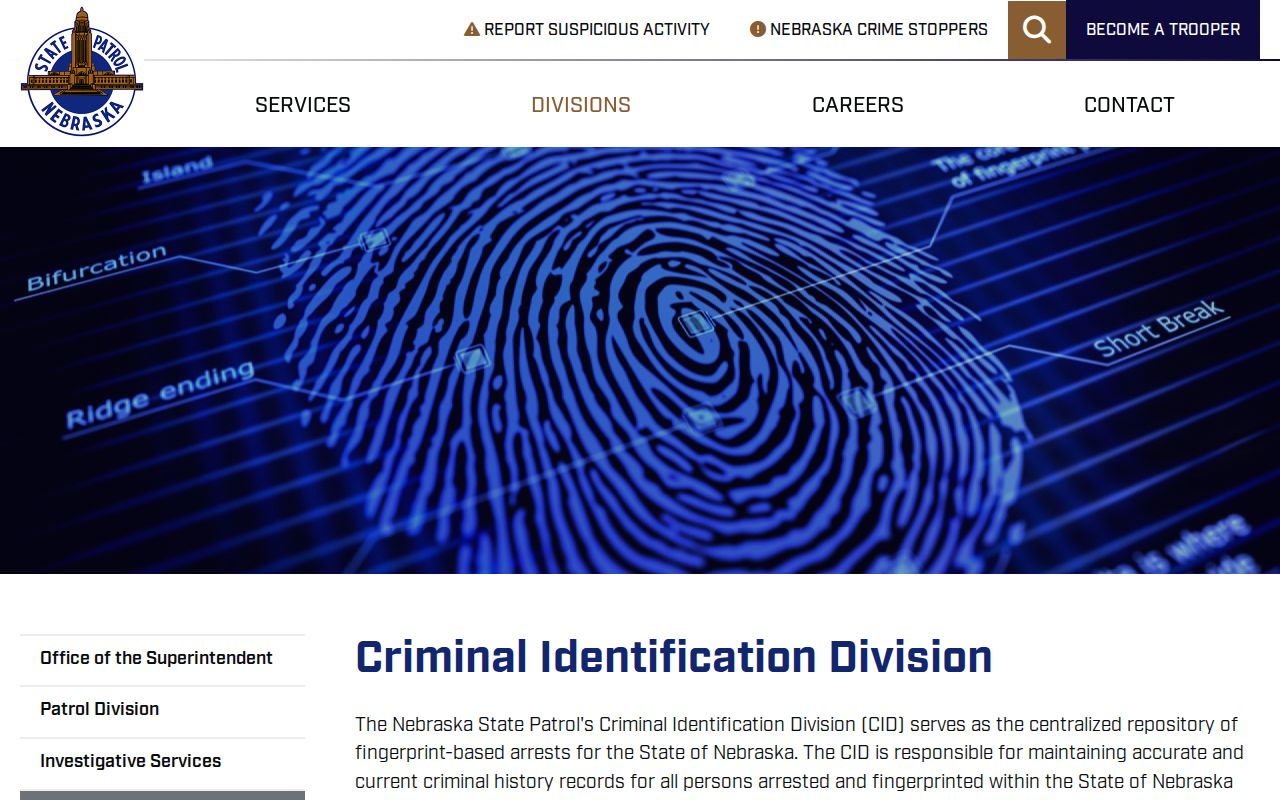
The Nebraska division also houses the Centralized Protection Order Office, Quality Assurance Improvement Program, NICS, research and redaction, and the Sex Offender Registry function. Nebraska CID reported 68 civilian employees across 11 teams in the third quarter of 2025. Its Nebraska holdings include nearly 400,000 hard-copy records, more than 1.7 million ten-print records, 1.5 million mugshots, and about 750,000 palm prints. Those Nebraska totals describe repository holdings, not a count of people convicted.
Nebraska State Patrol CID Since 1941
Nebraska's statewide identification flow began before the modern Patrol. Fingerprint and repository mandates date to 1921. The Nebraska Safety Patrol formed in 1937, and the State Bureau of Criminal Identification followed in 1941. NSP describes it as the nation's first state bureau of its kind. Nebraska then enacted the Security, Privacy, and Dissemination of Criminal History Information Act in 1978, creating the legal framework used for present-day criminal-history access.
Nebraska technology changed the file. Nebraska AFIS began on August 23, 1995, with five workstations. Nebraska updates arrived in 2003, 2007, and 2016. CID stopped opening new Nebraska paper jackets for first-time offenders in 2013, though it still scans and retains incoming arrest cards. The same year brought the Centralized Protection Order Office. QAIP began in 2014, and the Nebraska NICS team was added in 2017. This history explains why a current Nebraska RAP can combine old paper-derived material with newer LiveScan transactions.
What Checks Nebraska State Patrol Offers
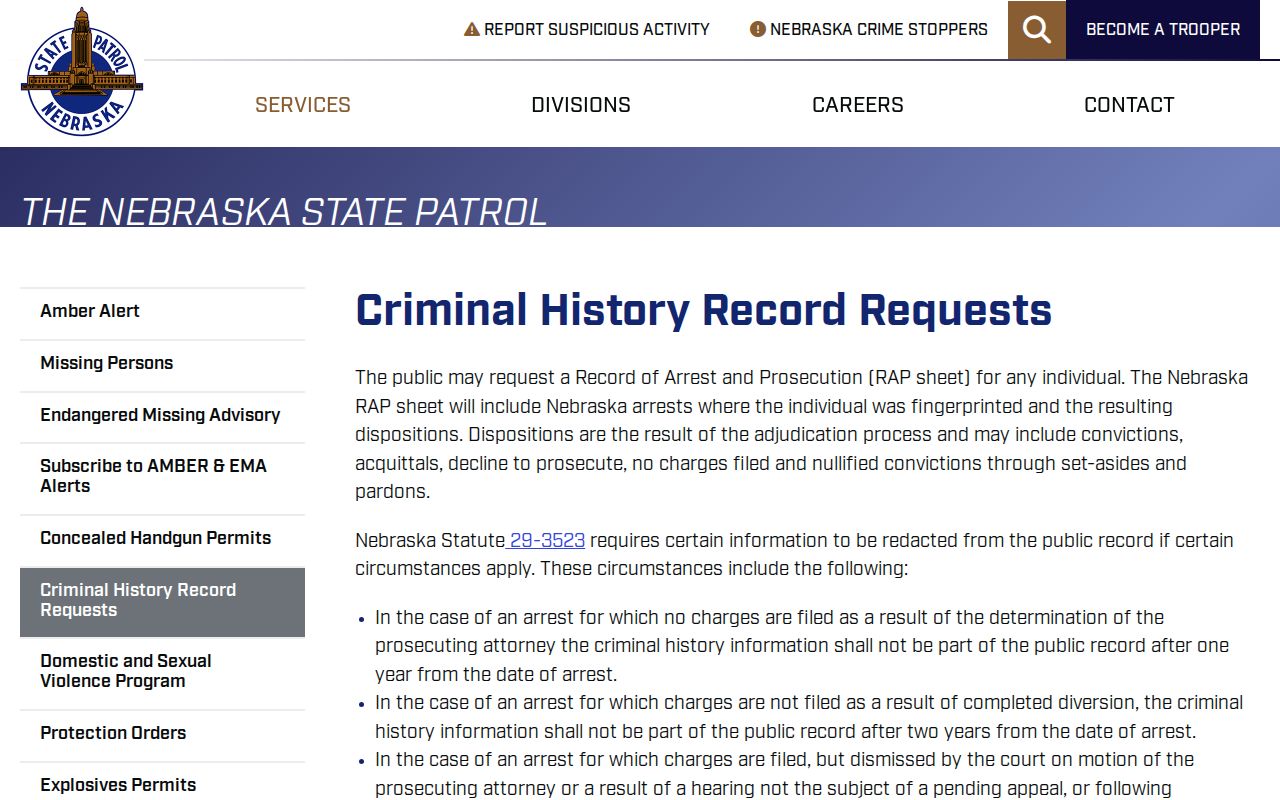
Nebraska State Patrol products differ by access and scope. Any requester may order the public Nebraska PCH or RAP for one adult. It contains Nebraska arrests supported by fingerprints and the dispositions CID received, after the public-view exclusions required by state law. A person reviewing their own history may ask for the complete view. Another requester needs that person's notarized release to receive the excluded complete-history categories.
The Nebraska State Patrol record-request page is the controlling source for current channels, fees, scope, and timing.
Nebraska authorized fingerprint checks are not open public name searches. They require a qualifying Nebraska statute or program, fresh fingerprints, and the correct Nebraska agency instructions. A personal FBI Identity History Summary is a separate national product available to the Nebraska subject through the FBI.
| Product | Who may order | What it returns | Current cost |
|---|---|---|---|
| Public Nebraska PCH/RAP | Any requester | Public Nebraska adult fingerprint-supported arrest cycles and received dispositions | $30, nonrefundable |
| Complete Nebraska history | Subject, or requester with notarized release | Authorized repository view including otherwise excluded categories | $30 |
| Certified or notarized RAP | Requester who expressly asks CID | NSP certification of the available RAP product | $30 base; no separate current surcharge located |
| Authorized state/FBI fingerprint result | Person in a qualifying statutory category | Purpose-specific result sent through the authorized route | Usually $55; some categories $65 or agency-paid |
| Record correction assistance | Person disputing their own entry | Source identification and repository update after source correction | No correction fee published |
Note: The $30 Nebraska public RAP and complete history use the same agency, but they disclose different statutory views.
Inside Nebraska State Patrol PCH
The Nebraska State Patrol Limited Criminal History portal begins with Nebraska requester identity and contact fields, then asks for the person of interest. First name, last name, date of birth, gender, and race are required for the Nebraska request. Middle names, former names, Social Security number, driver-license number, and residence can improve a Nebraska match. The Nebraska portal uses the first three letters of the first and last name, date of birth, and Social Security number when supplied. A Nebraska result that matches only two main criteria may be sent to a researcher.
| Requester | Full legal name, address, and email for delivery or research notice. |
|---|---|
| Required subject fields | First and last name, date of birth, gender, and race. |
| Useful variants | Middle, former, married, adopted, or other known names. |
| Optional identifiers | Social Security, driver-license, and residence details can reduce false matches. |
| Retrieval | Previous Orders requires the receipt number; reports remain online for 14 days. |
An error in a submitted Nebraska name, birth date, or Social Security number cannot be edited after payment. The Nebraska requester must place a new paid order. Store the Nebraska receipt number because CID cannot retrieve an online report without it. A Nebraska no-record result may appear in minutes and may not generate a ready email. An ambiguous Nebraska match can take up to three business days for human research.
Path Into Nebraska State Patrol Repository
A Nebraska sheriff, police department, Nebraska State Patrol trooper, or another authorized agency creates the incident and arrest record. A Nebraska booking agency then captures identity data and fingerprints. Qualifying Nebraska arrest data moves to CID by LiveScan or paper card. The Nebraska county attorney makes the charging decision, and the Nebraska trial court creates the case. Later, Nebraska justice partners send the disposition back to the repository.
Data flow: County Arrest › Fingerprint Submission › Nebraska State Patrol › Court Disposition Reporting › Rap Sheet
The fingerprint event and later disposition are linked through a transaction control number. Gaps still occur. Nebraska requires felony arrest fingerprints to be submitted, but misdemeanor and citation practice can differ. An agency may fail to forward a card. A source may use a different name, or a final outcome may arrive late. Thus, no PCH result does not prove that no arrest or court case exists. CID's Quality Assurance Improvement Program has worked with local justice partners since 2014 to improve completeness, accuracy, and timeliness. Yet the source remains essential. The creating agency owns the arrest fact, and the clerk owns the judgment. Use the Nebraska county directory when the underlying document or freshest local update is needed.
Note: Nebraska State Patrol can identify a source error, but the originating court or agency must validate and send the correction.
Nebraska State Patrol Fingerprint Network
Nebraska uses a state-run LiveScan network rather than a general IdentoGO or Fieldprint contract. Nebraska State Patrol troop sites in Omaha, Norfolk, Grand Island, North Platte, Scottsbluff, and Lincoln provide appointment-based services for eligible purposes. Some local law-enforcement agencies also offer capture. Hours and service types vary, and the agency does not publish one universal capture-only fee.
The official Nebraska State Patrol appointment calendar lets the user choose a location, date, and available time.
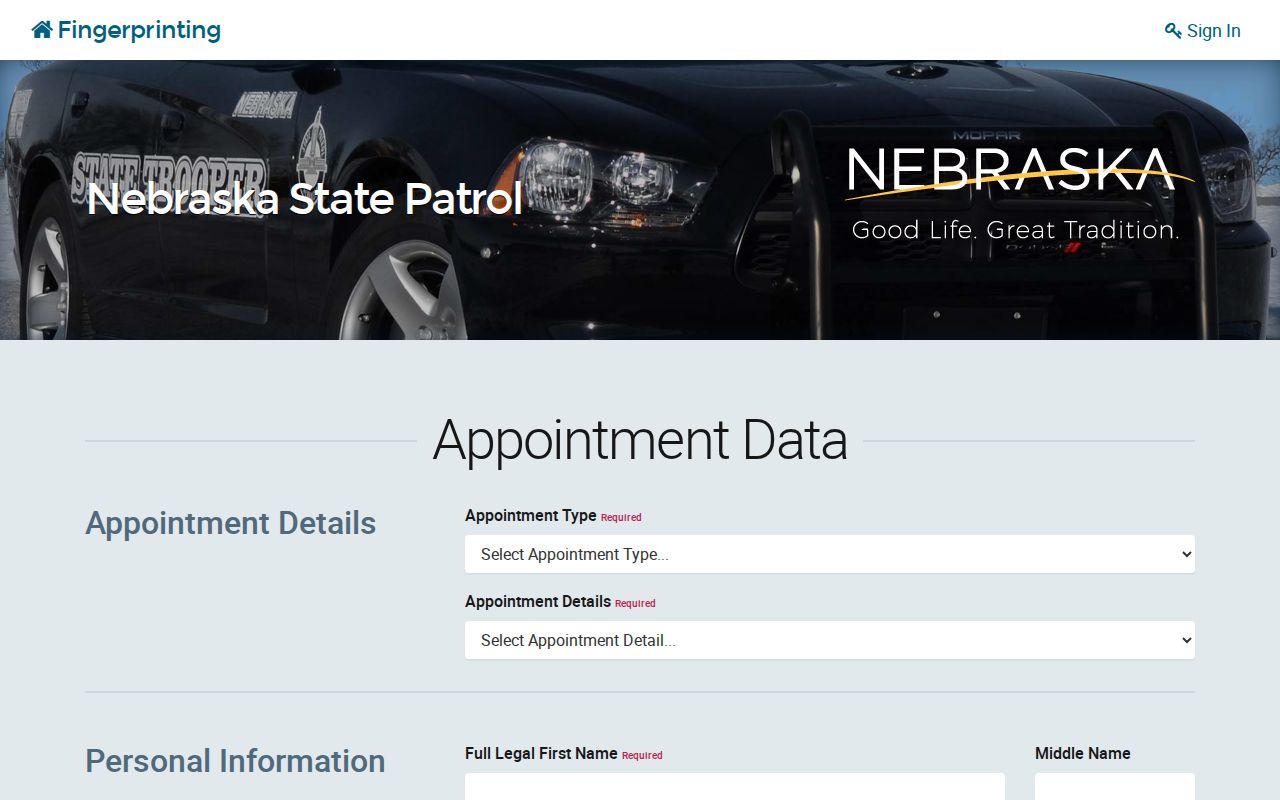
Bring the authorizing Nebraska agency's instructions, the correct ORI or category, and accepted identification. A current government photo ID works in Nebraska. Other combinations accepted in Nebraska may pair a nongovernment photo ID with a government nonphoto document. Old fingerprints are not reused for a fresh Nebraska authorized check. Low-quality prints submitted in Nebraska can trigger contact and a 60-day replacement window.
Note: The advertised $55 or $65 charge belongs to authorized check categories; it should not be presented as a universal fingerprint-service price.
Nebraska State Patrol Check Ordering Steps
Online, mail, and in-person channels all lead to Nebraska State Patrol CID, but they do not fit every request. The online PCH uses card payment. Mail uses Form 752 with the live $30 fee by cashier's check, personal check, or money order. A completed request can also be presented at an NSP troop area. Confirm local counter availability before travel.
- Choose the product. Use public PCH for a public Nebraska RAP, complete review for your own file, or the authorized fingerprint route when the governing program requires it.
- Gather exact identifiers and every known name. For complete third-party release, obtain the subject's notarized authorization.
- Submit online, mail Form 752, or use a troop-area counter. For fingerprint service, book the correct appointment and bring the program instructions.
- Pay the controlling live fee. Keep the online receipt and allow up to three business days when CID research is needed.
- Read each cycle, then obtain the county court judgment or agency record when an entry needs more detail or verification.
Form 752 revised in March 2024 still displays obsolete fee language in part of the PDF. The live Nebraska State Patrol service page controls: the current RAP charge is $30. A good-order mail request needs the completed form, payment, and any required signatures or release. Mail time comes after the agency's processing period.
Why Nebraska State Patrol and JUSTICE Differ
Nebraska State Patrol PCH and Judicial Branch JUSTICE are built from different events. PCH is a compiled, fingerprint-supported arrest chronology with dispositions received by CID. JUSTICE is the statewide case-management system for Nebraska County and District Courts. A court file can include the complaint or information, hearings, docket entries, orders, financial events, disposition, sentence, and public images. The RAP summarizes rather than reproduces that file.
A Nebraska booking label may change when the Nebraska county attorney files charges. A Nebraska JUSTICE case may appear roughly 24 hours after filing, while a Nebraska disposition can reach CID later. A nonfingerprinted Nebraska event may never reach PCH. Conversely, a Nebraska PCH cycle may refer to an arrest that did not produce a publicly disseminated case. Compare Nebraska identifiers and dates before deciding that one source is wrong. For case detail, the Nebraska Court Case Lookup route is the right companion to the repository check.
Comparing Nebraska State Patrol and County Records
The Nebraska State Patrol is the statewide source for fingerprint-supported Nebraska arrest cycles. Nebraska county offices hold the original facts. The Nebraska arresting agency keeps its incident and arrest report. A Nebraska jail keeps booking and current local custody data. Nebraska County and District Court clerks keep filed cases and judgments. Neither Nebraska layer replaces the other.
| Question | Nebraska State Patrol check | County source |
|---|---|---|
| Coverage | Adult Nebraska fingerprint-supported arrests from reporting agencies statewide | One county's agency, jail, or trial-court records |
| Identity anchor | Fingerprint event plus submitted identifiers | Case, incident, booking, and local identifiers |
| Freshness | Depends on fingerprint and disposition reporting | Updates as booking, filing, and judgment occur |
| Detail | Compiled RAP cycles and received outcomes | Narratives, docket events, orders, and certified judgments |
| Best fit | Statewide Nebraska chronology | A specific arrest, case, document, or current jail fact |
For police material, Nebraska Public Records Law gives a route to request an identified existing record, but investigative and protected information may be withheld. For courts, free courthouse JUSTICE terminals provide statewide access, while clerks can locate specifically identified files. Start with the question, not the database name.
Nebraska State Patrol AFIS Upgrade
Nebraska ratified the National Crime Prevention and Privacy Compact effective September 3, 2025. That step created a formal interstate and federal framework for noncriminal-justice criminal-history governance. It did not, by itself, prove completed enrollment in the FBI's National Fingerprint File. As of the research date, the FBI's July 2025 map still labeled Nebraska as an Interstate Identification Index participant only.
In September 2025, CID signed a $12 million AFIS replacement contract. Completion is projected for December 2027. The project adds automated ten-print and latent processing, multi-incident matching, and a five-year workstation refresh cycle. It builds on a network that had grown by 2023 to more than 20 AFIS workstations, 64 LiveScans, and 88 handheld mobile-identification units. Modern equipment can speed matching, but it cannot supply a fingerprint card or final disposition that a source never reported.
Nebraska State Patrol Public Record Requests
A RAP request and a public-record request are different channels. Use PCH when the question is a Nebraska criminal-history compilation. Use the Nebraska State Patrol public-record request process for an identified NSP crash, incident, administrative, or other existing agency record. NSP does not hold every city police or county sheriff report, and it need not create a new compilation to answer a request.
The official Nebraska State Patrol request page presents its GovQA and written-request route.
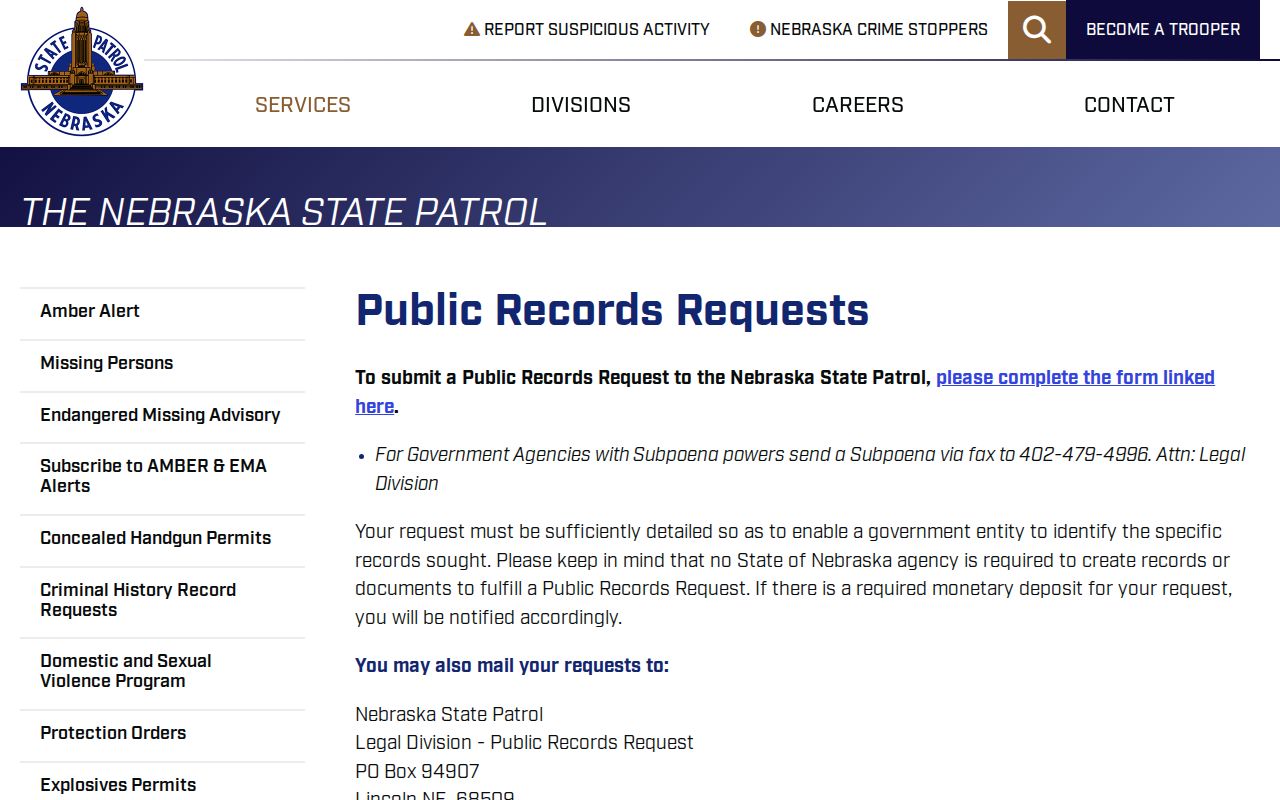
Under Neb. Rev. Stat. §84-712, the custodian generally has four business days to provide access, deny with a legal basis, give a cost estimate, or explain why more time is needed with a good-faith completion estimate. Nebraska residents receive the first eight cumulative employee hours of search, identification, copying, and redaction labor without labor charge. NSP then publishes clerk labor at $35 per hour, technician labor at $96 per hour, and paper copies at 25 cents per page. A deposit can be required when estimated copying cost exceeds $50.
Note: A Nebraska public-record request seeks identified agency material; it does not produce a new statewide criminal-history compilation.
Nebraska State Patrol Record Error Corrections
CID can identify the source of a disputed Nebraska entry, but it cannot change the record based only on a person's statement. The originating arrest agency, prosecutor, or court must validate the error and transmit the correction. This rule preserves the link between the repository summary and the government office that created the underlying fact.
- Order the complete Nebraska history for your own review and preserve each cycle, agency name, and case reference.
- Compare the disputed line with the arresting-agency record, prosecutor outcome, or signed county court judgment.
- Call CID at 402-479-4971 if the source is unclear, then ask that source to correct its record and send the update directly to NSP.
- After processing, review a fresh repository copy and confirm that the court file and Nebraska State Patrol display now agree.
Nebraska public dissemination limits also matter. Section 29-3523 excludes specified Nebraska no-charge events after one year, diversion or no-charge events after two years, and qualifying dismissals or acquittals under statutory conditions. A complete authorized Nebraska history can still contain those categories. Nebraska set-aside relief under §29-2264 changes legal effect but does not erase the conviction. Narrow Nebraska expungement applies to an arrest caused by law-enforcement error. Verify any order both in the Nebraska county docket and in the repository record.